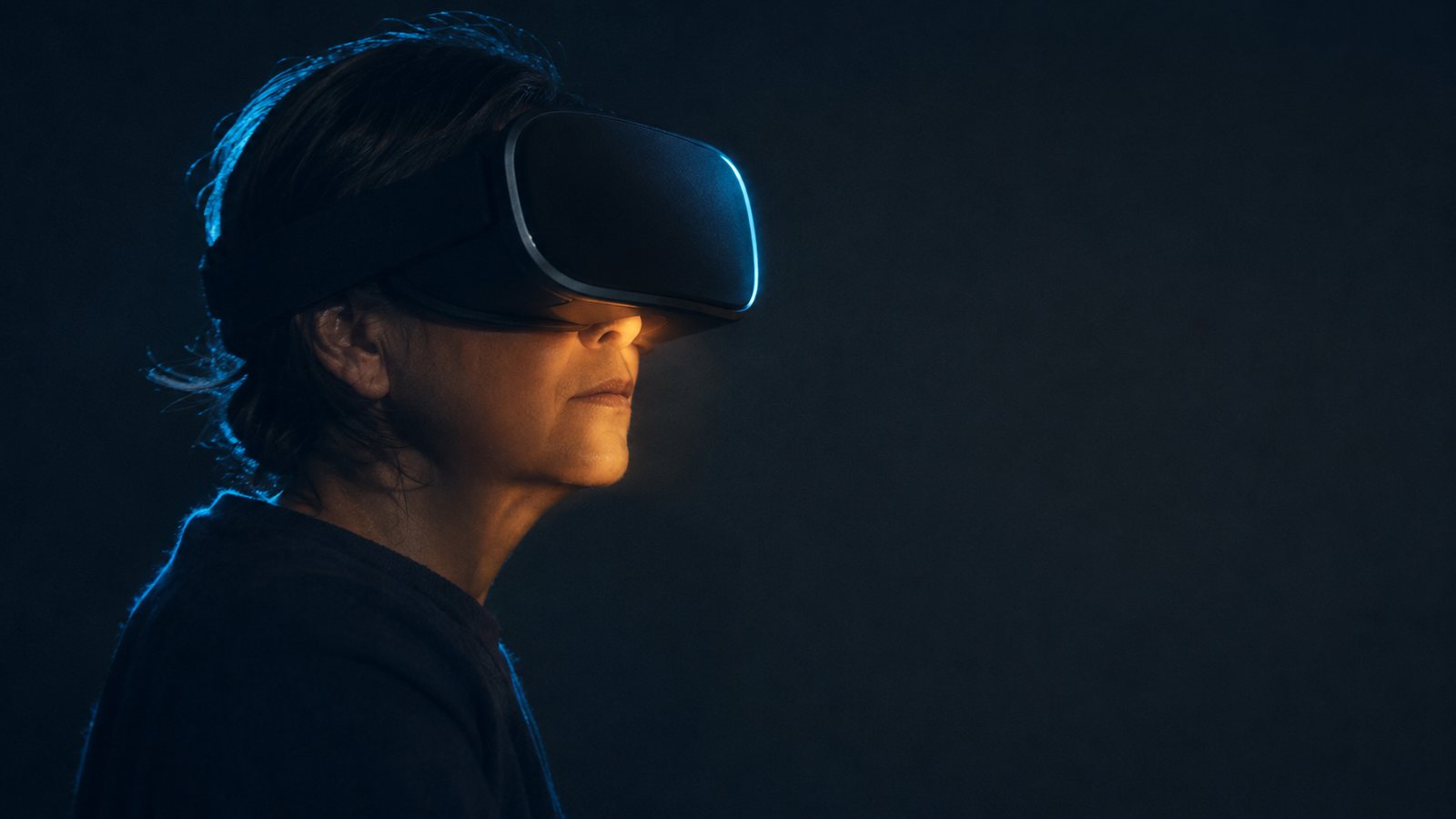
An immersive headset is, from the standpoint of memory research, an instrument with a rare property: it controls almost the entirety of the perceptual stimulus of the person wearing it, and at the same time it lets that person's response be measured. The two together, stimulus control and response observability, are what makes immersive environments interesting to those who study how memories form, are reconstructed and, under specific conditions, allow themselves to be modified. This article reconstructs what the experimental literature has established, what remains contested and where, within this picture, the research lines of the MNEMOS™ project stand.
Memory is reconstructive: the starting point
Cognitive psychology abandoned the recording model of memory decades ago. Remembering is a reconstructive act, sensitive to post-event information and to the context of recall, and for this reason exposed to systematic error as well as to simple forgetting. The reference framework for these errors is source monitoring: attributing a mental content to its origin, perception, imagination or someone else's account, is a judgement, and like every judgement it can fail (Johnson, Hashtroudi and Lindsay, 1993).
On this basis, research has shown with different paradigms how permeable autobiographical memory is. The misinformation paradigm and the implantation of entire events that never happened have been documented since the nineties (Loftus and Pickrell, 1995); the mere repeated imagination of an event increases subjective confidence of having lived it, the so-called imagination inflation (Garry et al., 1996); a doctored photograph is enough to make part of the participants «remember» a hot-air balloon ride that never took place (Wade et al., 2002). More recently, images and videos edited with generative tools have shown the same effect with greater intensity (Pataranutaporn et al., CHI 2025).
What immersion adds
If a static photograph can interfere with memory, an immersive environment raises the question at a different level, for three documentable reasons. The first is presence: a well-built immersive environment produces the sensation of being in a place, not of looking at it, and first-person experience is the raw material of episodic memory. The second is the multisensory, spatial richness of the stimulus, which brings encoding conditions closer to those of a real event. The third is that the effect on memory has already been observed experimentally: in a by now classic study, preschool children exposed to an immersive experience developed false memories of the simulated event as easily as they did by imagining it (Segovia and Bailenson, 2009).
What these results do not show must be said with the same clarity: they do not show that a complex autobiographical memory can be implanted at will in an aware adult, nor that the effect is stable over time or robust outside the laboratory. The distance between «a detail misremembered» and «an experience never lived remembered as one's own» remains wide, and the literature advises against crossing it with enthusiasm.
From static content to the closed loop
All the studies cited share an architectural limitation: the stimulus is fixed, identical for every participant, and the person's response is measured afterwards, with questionnaires and recognition tasks. It is an open-loop architecture: the stimulus knows nothing of the effect it is producing.
The more interesting, and technically more demanding, direction is closing the loop: measuring the person's response while the experience is under way and using that measurement to decide how to build the next version of the experience itself. The signals for doing so exist and have long been studied: eye movements distinguish the exploration of a new scene from the revisiting of a familiar one (Ryan et al., 2000), and peripheral physiological responses accompany recognition in measurable ways. None of these signals, alone, is a readout of memory; together, they allow a familiarity index to be estimated without asking the person, which matters, because the explicit question «do you recognise it?» alters precisely the process one is trying to measure.
The MNEMOS research lines
It is at this point of the picture that MNEMOS™ (Memory Narrative Encoding & Modulation Observational System) stands, the closed-loop system on which patent application for industrial invention no. 102026000024559 has been filed. Three choices define it. The first is narrative-constrained generation: the experience is not invented around the person, but generated within the limits of what the person has confirmed of their own past, and a scene that contradicts that model is not presented. The second is measurement through observable signals: during the experience the system estimates a familiarity index from physiological and behavioural signals, without relying on self-report alone. The third is iterative adaptation: the index steers the next generation according to predefined criteria and thresholds, and the loop stops when a threshold is reached, when the measure stops moving or when someone stops it.
The base configuration uses instruments a person can take off; a neural interface is contemplated as a possibility, not as a requirement, and the system is not a medical device. The scientific question the project keeps open is phrased with deliberate caution: not «how do you rewrite a memory», but whether an experience built under these constraints can become a memory, for whom, with what stability and with what markers distinguishing it from a memory of perceptual origin.
The road MNEMOS does not take
A second road exists, conceptually opposite: intervening on a memory that already exists, exploiting the window of lability that follows recall, reconsolidation. In animal models the phenomenon is amply documented (Nader, Schafe and LeDoux, 2000); in humans the results are heterogeneous and several replication attempts have failed, to the point that the most careful reviews advise distinguishing what is established, what is contested and what is simply misunderstood (Elsey, Van Ast and Kindt, 2018). MNEMOS is not a reconsolidation system: the line on existing memory remains, within the project, separate exploratory research, not patented and declared as such.
The questions that matter more than the technique
A technology capable even merely of influencing the reconstruction of memories touches individual autonomy, identity and informed consent. Some requirements are, in our judgement, non-negotiable: consent cannot be generic, because the person must know the experience is constructed and retain the right to interrupt it; the distinction between a memory of perceptual origin and a generated experience must remain traceable in the system even were it to stop being so in the person; and applications to psychological distress, if they ever come, belong to regulated clinical research, under professional supervision, not to a product. These are the same criteria with which the recent literature discusses therapeutic applications of memory modification, and the reason a serious project in this area is measured as much by its protocols as by its algorithms.
References: Johnson M.K., Hashtroudi S., Lindsay D.S., «Source Monitoring», Psychological Bulletin, 114(1), 1993 · Loftus E.F., Pickrell J.E., «The Formation of False Memories», Psychiatric Annals, 25(12), 1995 · Garry M. et al., «Imagination Inflation», Psychonomic Bulletin & Review, 3(2), 1996 · Wade K.A. et al., «A Picture Is Worth a Thousand Lies», Psychonomic Bulletin & Review, 9(3), 2002 · Segovia K.Y., Bailenson J.N., «Virtually True», Media Psychology, 12(4), 2009 · Ryan J.D. et al., «Amnesia Is a Deficit in Relational Memory», Psychological Science, 11(6), 2000 · Nader K., Schafe G.E., LeDoux J.E., Nature, 406, 2000 · Elsey J.W.B., Van Ast V.A., Kindt M., «Human Memory Reconsolidation», Psychological Bulletin, 144(8), 2018 · Pataranutaporn P. et al., «Synthetic Human Memories», CHI 2025.
Analytiko · 2 September 2026