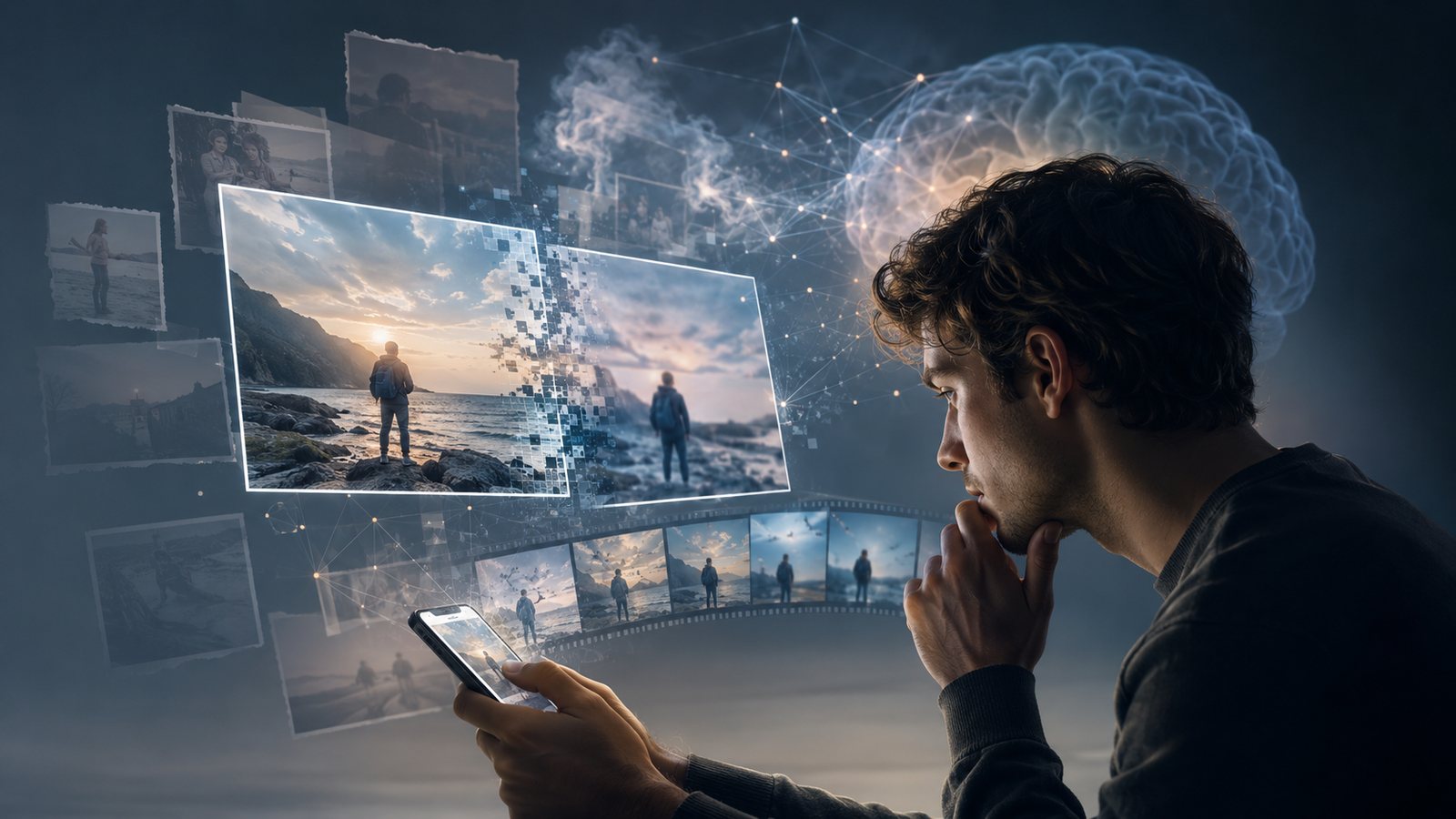
We are used to discussing generative AI in terms of the truthfulness of content: is a photograph authentic, or has it been altered? Does a video actually document something, or is it synthetic?
The question posed by a group of researchers from the MIT Media Lab, the University of the Thai Chamber of Commerce, and the University of California Irvine is more radical: what happens to our memory after we see an AI-edited version of something we had already seen?
The paper, Synthetic Human Memories: AI-Edited Images and Videos Can Implant False Memories and Distort Recollection, was published as part of the CHI Conference on Human Factors in Computing Systems 2025, and its authors include Elizabeth Loftus, one of the world's leading scholars on the malleability of memory.
The experimental conclusion is unambiguous: exposure to AI-edited images increases the likelihood that a person will recall details that were not present in the original image. And the effect grows even stronger once those images are turned into video.
Memory Is Not a Recording
The result is less surprising to cognitive psychology than it might seem. Human memory does not work like an archive in which an episode is recorded once and for all and later retrieved unchanged. Remembering means, at least in part, reconstructing. Research on false memories has shown for decades that leading questions, information encountered after an event, and manipulated photographs can all reshape the memory a person holds of what they experienced.
The leap introduced by AI is mainly quantitative and technological. A photo manipulation that once required skill, time, and deliberate intent can now be produced automatically, in a matter of seconds, and with a very high degree of realism. The authors highlight exactly this shift: AI makes editing our "externalized memories" — the photos and videos we rely on to remember — dramatically more accessible and scalable.
And a photograph does not simply preserve a moment. Every time we look at it again, it can help reconstruct that moment.
The Experiment
The researchers ran a preregistered study with 200 participants, randomly split into four groups. All participants first viewed 24 original photographs. After a brief distractor task, each group was exposed to a different condition:
- unaltered original photographs;
- AI-edited photographs;
- AI-generated videos based on the original photographs;
- AI-generated videos based on photographs that had already been AI-edited.
The alterations affected people, objects, and settings: they could change a person's facial expression or ethnicity, the time of day, remove elements from the scene, or add objects such as a military vehicle. Participants were then asked to recall the original images, not the manipulated ones.
This is where the key finding emerges.
AI Can "Rewrite" What We Remember
Compared with the control group, AI-edited photographs produced 1.67 times more false memories. Videos generated from unaltered photographs produced a more modest increase, around 1.25 times. But the most powerful condition was the one in which a photograph was first AI-edited and then turned into a generative video: in that case, false memories were 2.05 times those of the control group. It is not just the amount of error that changes.
Something psychologically far more significant changes too: the confidence with which the error is remembered. In the group exposed to videos generated from previously manipulated images, confidence in false memories was about 1.19 times higher than in the control group. In other words, AI does not seem to only increase the chance of remembering something that was not there. It can also increase the conviction that the memory is genuine.
The Problem Isn't Just Deepfakes
The study highlights an interesting distinction. A deepfake typically builds an entirely artificial piece of content, which can trigger a certain degree of suspicion in the viewer. An AI edit, by contrast, starts from something real. An authentic photograph is altered, sometimes only minimally: a person removed, a detail added, a setting slightly transformed.
It is precisely this continuity with the original that could make it especially insidious.
We are no longer talking only about the falsification of present information, but about the possible retroactive alteration of how the past is represented. The authors go so far as to note that generative systems could affect not only individual memory but also collective memory and the reconstruction of social or historical events.
The potential consequences are obvious: courtroom testimony, political information, journalistic documentation, family archives, social media.
But there is also another side to the problem, and it is probably the most scientifically interesting part of the work.
If an artificial representation can unintentionally contribute to the formation of a false memory, could we deliberately use that same mechanism to change the emotional weight attached to how an experience is remembered?
The authors take this possibility seriously. They speak explicitly of therapeutic memory reframing: AI could be used, under professional supervision, to modify elements associated with traumatic memories and encourage the formation of emotionally less distressing associations. Among the fields mentioned as possible applications are PTSD, phobias, and anxiety disorders. An image linked to a painful episode could, for instance, be progressively reinterpreted through different visual versions.
This would not necessarily mean "erasing" a memory. It could instead mean intervening in how that memory is reconstructed and in the emotional meaning attached to it. And this is precisely where the line between technology, neuroscience, psychology, and ethics becomes very thin.
From Correcting an Image to Designing the Memory Experience
The paper does not show that it is possible to arbitrarily implant complex autobiographical memories. This distinction is essential. The experiment concerns the recollection of visual details observed just minutes earlier, within a controlled experimental setting. It does not show that a system can artificially create an entire autobiographical experience or permanently replace a consolidated memory.
The researchers themselves acknowledge several limitations: brief exposure, only 200 U.S. participants, just 24 preselected images, and the absence of participants' own personal photographs. They accordingly call for longitudinal studies, the use of personal memories, more naturalistic experiments, and analysis that also covers text and audio content.
But it is precisely this limitation that makes the next question so interesting.
No longer just:
"Can synthetic content alter a memory?"
The data are starting to suggest it can.
The next question becomes:
"Can this interaction between artificial content and human memory be designed in a controlled, measurable, and reversible way?"
That means moving from generating images to designing systems capable of observing an individual's response, progressively adapting the stimulus, and measuring how their mental representation evolves.
It is a research frontier very different from simple generative AI.
The Decisive Problem Will Be Ethics
The authors are very cautious on this point. A technology capable of influencing even just the reconstruction of memories touches directly on individual autonomy, personal identity, informed consent, and the integrity of autobiographical experience. For the same reasons it could have therapeutic value, it could also enable extremely problematic applications.
Who decides which memory should be modified? To what extent is it legitimate to soften the negative elements of an experience? How do we preserve the distinction between what actually happened and what was later reconstructed? And above all: who holds the right to intervene in another person's memory?
The study explicitly points to the need for transparency, informed consent, safeguards against political or personal misuse, privacy protection, and professional supervision in any therapeutic applications.
These are issues that will probably not be resolved by engineers alone. They will require cognitive and clinical psychologists, neuroscientists, Human-Computer Interaction experts, legal scholars, bioethicists, and AI specialists.
A New Discipline May Be Just Beginning
For many years, we thought of AI as a technology capable of producing information. Then we began to see it as a technology capable of producing experiences. The research by Pataranutaporn and colleagues suggests a further shift: artificially generated experiences can interfere with how we reconstruct real ones. This does not mean we already have a technology for programming human memory. It means something perhaps even more important from a scientific standpoint: we now have initial experimental evidence that the interaction between generative AI and memory can be measured. And once a phenomenon becomes measurable, it can become the object of systematic research. For those working at the intersection of AI, behavior, and cognition, it is hard to imagine a more delicate research territory today.
Or a more interesting one.
Source: Pataranutaporn P., Archiwaranguprok C., Chan S.W.T., Loftus E., Maes P., "Synthetic Human Memories: AI-Edited Images and Videos Can Implant False Memories and Distort Recollection," CHI Conference on Human Factors in Computing Systems, 2025.
Analytiko · 28 August 2026